
For CIOs, CTOs, and IT Directors in enterprise environments
Automation Testing:
Quality Architecture That Reduces Risk in Every Release
We design, implement, or redesign your test automation with Omniatest®, the framework that standardizes architecture, data, and governance from the first sprint.

Trusted by organizations in regulated sectors: banking, insurance, manufacturing, retail, and more






























The problem isn’t automation; it’s what’s missing behind it
Three Scenarios, One Business Risk
No Automation
All regression falls on the manual team. Every release forces a choice between an incomplete launch or delaying time-to-market. Each new feature adds burden, it doesn’t remove it.
Automation, Without Strategy
There are scripts, but no real framework or pipeline. One or two people sustain the operation and become indispensable. When they rotate, the investment returns to zero, and maintenance already cost more than the value it generated.
Automation, Without Governance
Multiple squads and vendors, large suites, and inconsistent results. Coverage is high on paper and low in production. AI operates in silos, adding complexity without reducing risk. Every release is an event of uncertainty for management.
Whatever your scenario, the root cause is the same: quality is not designed with the strategy, architecture, and framework the business needs. That’s what we design.
The cost of poor quality doesn’t appear in the IT budget; it appears in the business’s bottom line
The annual cost of poor software quality globally
– CISQ (Consortium for Information & Software Quality)
| <5% |
Rate of failed changes in production, |
| 71% |
of engineering leaders |
| 63% |
Fewer errors |
Where does the real cost appear in your organization?
Unbudgeted hotfixes and emergency rework that consumes time from the most critical teams
Regulatory fines for compliance incidents before CNBV, Condusef, or sectoral authorities
Postponed releases and blocked development waiting for regression cycles that can’t test everything
Maintenance of fragile scripts that consumes more time than the value they generate
Erosion of executive trust in IT when incidents do not decrease despite investment
Competitive lag compared to organizations already operating with AI capabilities in automation vs. manual maintenance
Omniatest®, MTP’s Own Framework
We don’t promise automation: we deliver the results only achieved with method, experience, and support
Omniatest® standardizes architecture, data, and environments from the first sprint. Operations don’t fail when the team rotates or when the product grows.

Method That Doesn't Depend on People
AI with Traceability for the Auditor
Governance in Complex Multi-Vendor Environments
Trust Measured in Delivered Projects
When Automation Is Governed
Results the business recognizes, not just the technical team
Cross-Functional Governance
Clear RACI, standardized quality gates between squads and vendors. Quality ceases to depend on individuals and becomes an institutional process.
Risk-Based Testing
Prioritization based on financial and regulatory impact. Automation resources are concentrated where a failure would have the greatest consequence for the business.
Continuous Testing Enterprise
Real integration into CI/CD and DevSecOps, not in parallel. Each commit triggers automated coverage without blocking the development pipeline.
Sustainable Automation Testing + AI
Architecture designed to reduce instability and accelerate the process of each release. Self-healing and predictive regression under Human-in-the-Loop.
Data-driven prediction
Dynamic prioritization of regression and early detection of degradation. The CIO gains risk visibility before the release, not after the incident.
+35% in Time Optimization
Reduction of time in executing traditional testing tasks using AI as a tool, without compromising coverage or governance.
AUTOMATION TESTING OPERATIONAL PROCESS
From Unpredictable Releases to a Reliable Pipeline: How We Operate
Structured Quick Assessment
Potential ROI, projected TCO, current flakiness level, stack complexity. Deliverable in 5 business days.
Criticality and Exposure Mapping
Identification of flows with the highest financial and regulatory risk. Prioritization of what to automate first.
Architecture Design
Automation framework, technical standards, definition of quality gates, and governance model.
Integrated CI/CD Implementation
Automation connected to the real pipeline, not in parallel.
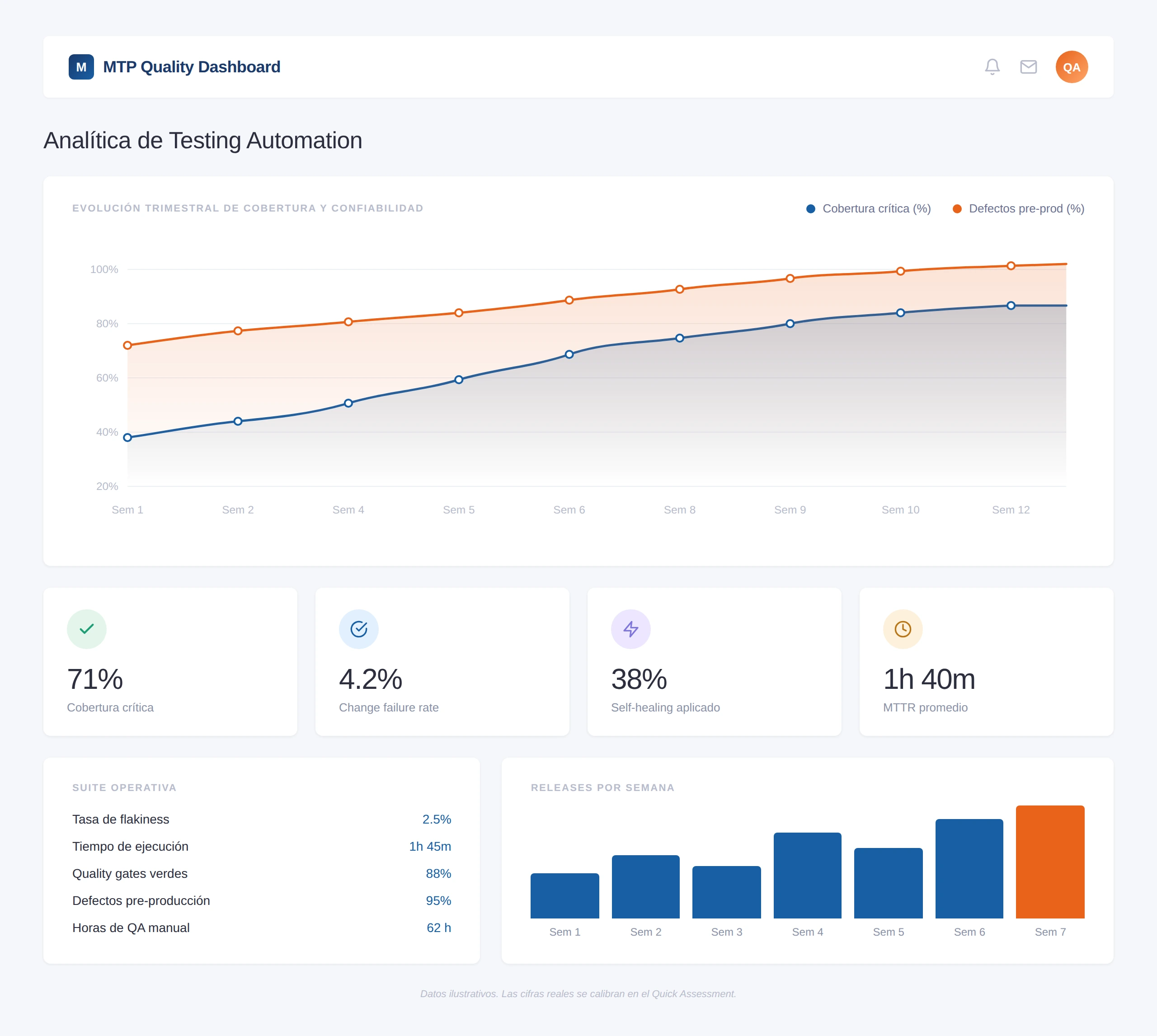
Executive and Technical Dashboard
Unified visibility for management and the team. Comparable metrics between squads and vendors.
Continuous Optimization
Evolutionary maintenance, progressive reduction of flakiness, risk-oriented coverage expansion.
Experience in Environments Where Error Is Not an Option
Two Contexts, Same Demand: Zero Margin for Error
Financial Sector
Multi-Vendor Governance in a Top-Tier Financial Institution
- +30 simultaneous initiatives governed
- +900,000 annual executions
- Regulated CNBV and Mission-Critical Environments
- Multi-application and multi-vendor under a single framework
“We stabilized our pipeline and today we release with greater confidence to Management. Automation ceased to be a risk.”
— IT Director, Financial Sector
Private Industry
18 Critical Applications in SOX Systems Separation
- +20,000 hours of execution and automation
- From 3-month delays to controlled deliveries without deviations
- Guaranteed continuity in SOX processes: payroll, tax reports, payments
- End-to-end coverage in mission-critical systems
A project of this magnitude —18 critical applications, parallel SOX processes— requires method, not just resources. The difference was the architecture.
— Operations Director, MTP
Verified operational scale
12 Years of Experience in Mexico’s Most Demanding Environments
Issues Detected
Automated Test Cases
Testing Hours
Test Cases Designed
Evaluation stage
Most Frequently Asked Questions About Automation Testing
What is Automation Testing in an Enterprise Environment?
It is the systematic and governed execution of automated tests to validate that software functions correctly after each change, reducing manual regression, increasing release stability, and generating early executive visibility.
What is the Difference Between Traditional Automation and Risk-Oriented Automation?
Traditional automation seeks to increase script volume and percentage coverage. Risk-oriented automation prioritizes what to test based on real financial, regulatory, or operational impact, ensuring resources are concentrated where a failure would have the greatest consequence.
How is Flakiness Reduced in Enterprise Automation Suites?
By redesigning test data management, adopting a layered architecture (API-first where applicable), stabilizing test environments, controlling external dependencies, and eliminating fragile synchronizations. Without addressing the architectural root cause, flakiness returns.
How is the ROI / TCO of Automation Justified to the CFO?
By measuring the cost of manual versus automated regression, the cost of post-release incidents (hotfixes, rework, SLA penalties), the cost of maintaining suites with accumulated debt, and the impact on time-to-market. Governed automation quantifiably reduces COPQ.
How Does Automation Reduce Risk for the CIO / CTO?
By detecting critical failures before production, standardizing quality gates and metrics across teams and vendors, increasing release predictability, and decreasing post-deployment incidents. The CIO moves from managing crises to having early visibility.
How is AI Used in Enterprise Test Automation?
At four levels according to maturity and compliance: assistance, improvement, prediction, and automation/agents. Always under Human-in-the-Loop for critical decisions. The adoption level is calibrated to the regulatory restrictions and operational maturity of each organization.
What Are the Signs That Your Automation Isn't Working?
Persistent flakiness and frequent false negatives. A suite that runs but doesn’t generate confidence in management. Coverage that grows but defects reach production. A pipeline that skips tests to release faster. Script maintenance that consumes more time than the value it generates.
What is Human-in-the-Loop in Automation with AI?
A governance principle that establishes that critical decisions—releasing to production, excluding regression tests, modifying quality gates—require explicit human validation, even when AI recommends or executes actions autonomously.
Which of the three scenarios is your organization in?
The 5-business-day Assessment maps your current level of flakiness, projected TCO, and potential ROI, providing a concrete deliverable to present to management.