
For areas WHERE DATA IS CRITICAL
Data Testing: data integrity in every migration, pipeline, and critical process
We validate your data integrity with Quality Engineering, ensuring every decision, report, and model operates on reliable information.

Trusted by organizations where a single error is an operational, regulatory, or reputational problem.































When data quality is not designed, the business pays the price
The cost of defective data appears in: wrong decisions, invisible rework, and AI that does not scale
Reports that the CFO does not recognize the day after the new system launch.
Manual reconciliations at every month-end because no one validated the consolidation of sources beforehand.
Data teams trapped cleaning information by hand instead of generating analytical value.
Fines and observations when data fails to withstand a regulatory or external audit.
AI models that amplify duplicates and broken references instead of filtering them.
Lagging behind organizations that already validate data with AI under governance and scale models in production.
Three Scenarios, One Business Risk
The problem is not the data, it is what is missing behind it: strategy, validation per layers, and source governance
In the organizations we advise, we see three scenarios. All three end the same way: when data integrity is not designed from the start, the cost is absorbed by the regulatory report, the management decision, or the AI model in production.
Without data validation
Data moves, transforms, and loads without anyone verifying that business rules remain valid at the destination. The first executive report from the new system shows figures no one recognizes, and the month-end close is delayed by a week.
Late and manual validation
There is a team and willingness, but controls are executed late: Excel sampling, ad-hoc validations by source owners. The error appears only after it has impacted a customer, a regulatory report, or a management decision.
Critical pipelines without governance
The organization has already migrated, has a Data Lake, and is training models. But without formal source owners or automatic controls in pipelines, AI amplifies silent errors instead of detecting them.
Whatever your scenario, the root cause is the same: data quality is not designed with the strategy, architecture, and method the business needs. That is what we design.
Why MTP for Data Testing?
We don’t just promise Data Testing: we deliver the results that only come with method, experience, and support
Data Traceability
Data Traceability
We apply Omniatest®, our Quality Engineering methodology, to the data cycle: audited rules in every transformation and field-by-field comparison between source and destination.
Confidence in Critical Projects
Confidence in Critical Projects
AI with Human Supervision
AI with Human Supervision
Experience in Critical Operations
Experience in Critical Operations
WHAT CHANGES WHEN DATA IS RELIABLE IN EVERY RELEASE
Results that the business recognizes, not just the data team
Reliable decisions, not permanent reconciliations
Reports reconcile without an analyst having to explain every difference. Management decides based on figures, not on theories about why they changed.
Controlled regulatory exposure, not improvised audits
Audit trails and full traceability for applicable frameworks. Compliance stops extracting evidence by hand every time a request arrives.
Errors detected in the pipeline, not in the CFO's report
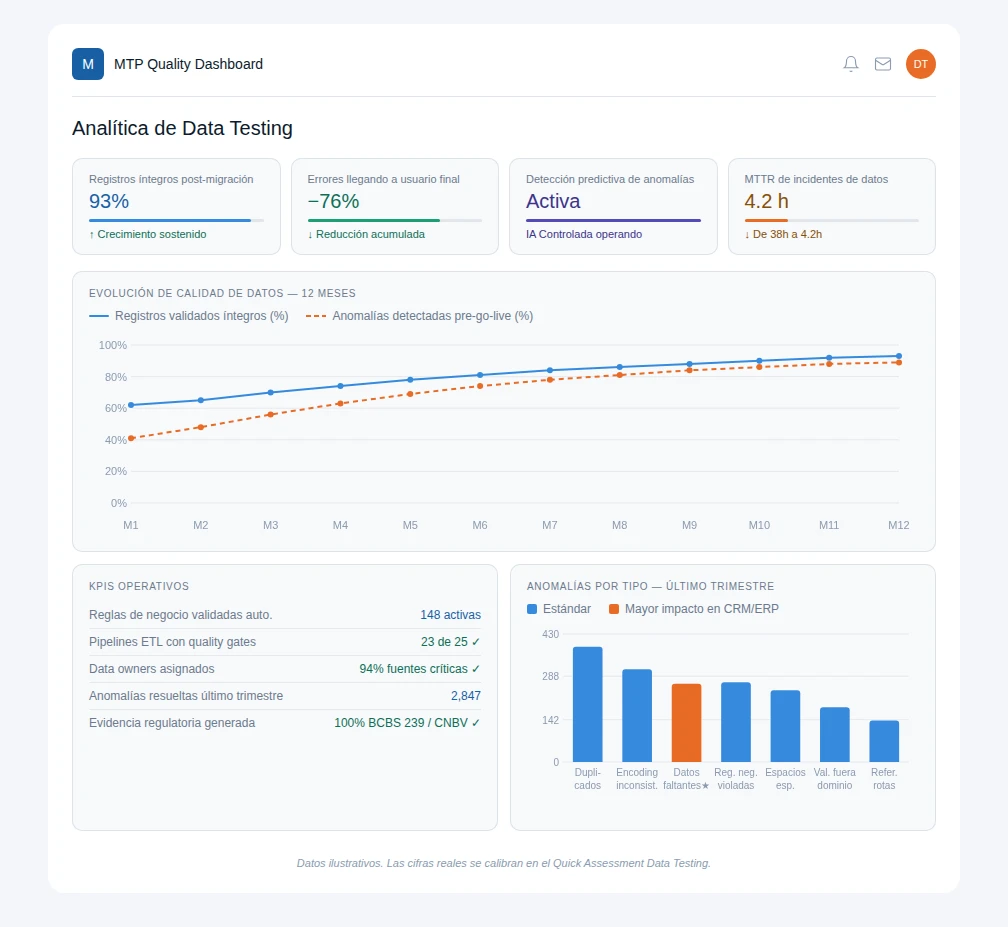
Automatic controls block defective loads before they reach the CRM, ERP, executive dashboards, or models. The problem is contained near the source, not the affected user.
Repair time in hours, not days
The executive dashboard identifies the exact point where the error appears. Operations repairs in hours what previously took days of cross-team investigation.
AI enabled for production, not stuck in pilot
Models receive intact data and generate reliable recommendations. Your organization stops having data quality as a barrier to scaling AI.
Experience in Environments Where Error Is Not an Option
Data Testing operational process
From unvalidated data to integrity in every load—this is how we operate
Data Quick Assessment
We map critical sources, pipelines at risk, and business rules. We deliver a diagnosis and a 90-day plan with clear priorities.
Design of Quality Criteria
We define criteria for completeness, consistency, conformity, and integrity by domain, aligned with the regulatory framework and best practices.
Integrity and Rules Validation
We verify that every record reaches the destination complete, without duplicates or losses, with rules applied at every transformation.
Anomaly Detection with AI and Human Supervision
AI identifies inconsistent formats, duplicates, and strange patterns. Every critical decision has traceability for auditing.
Automatic Controls in Pipelines and Continuous Integration
We implement controls with clear pass/fail criteria, integrated into your stack: dbt, Airflow, Azure Data Factory, AWS Glue.
Continuous Operation and Transfer
We provide support with formal source owners and active governance. MTP remains a partner for new pipelines, models, and audits.
Operational Scale for Organizations
Over more than 12 years of experience in Mexico, we have helped our clients solve the most complex QA challenges.
Issues Detected
Automated Test Cases
Testing Hours
Test Cases Designed
What we are asked most often about Data Testing
What tools and technologies does MTP use in Data Testing?
MTP uses industry-standard tools and adapts to those your team already uses, without imposing replacements. We work with validation engines (dbt tests, Great Expectations, Soda), data quality platforms (Informatica DQ, Talend DQ, Ataccama), orchestrators (Airflow, Azure Data Factory, AWS Glue), and cloud environments (Snowflake, Databricks, BigQuery, Synapse). The final selection is defined in the Quick Assessment based on your situation, applicable regulations, and governance maturity.
How is full data traceability validated from its source to the final report?
Full traceability means that every piece of data in a report can be traced back to its source system, with all transformations documented. The MTP Framework validates in three layers: source (source profiling and active rules), transformation (each rule audited with input and output), and destination (field-by-field comparison against the final report). Evidence is ready for auditing without manual reconstructions, whether for a financial regulator, an external audit, or a management decision.
How does AI anomaly detection work without breaking regulatory compliance?
We operate a Controlled AI model: AI identifies strange patterns in format, duplicates, violated rules, and broken references, but critical decisions require human validation and are recorded in an audit trail. In environments where human traceability is mandatory—personal data protection, financial reporting, sectoral regulations—we work with Controlled AI or No AI as appropriate. AI accelerates detection without breaking compliance: it assists the validator, it does not replace them.
How are duplicates and format errors reduced in loads to operating systems?
Duplicates and format errors are reduced with automatic controls at three points: profiling each source before loading, deduplication rules combined with advanced techniques for complex cases, and pre-load controls that block records outside the criteria. Controlled AI detects patterns that traditional rules do not capture—mixed formats, inconsistent abbreviations, broken dates—and marks them for human review before loading into CRM, ERP, data warehouses, or operating systems.
How long does the Data Testing Quick Assessment last and what does it deliver?
The Data Testing Quick Assessment lasts 5 business days and is free. It includes interviews with data, architecture, and compliance leads; review of critical sources and pipelines; identification of integrity risks and regulatory exposure; and delivery of a diagnosis with a 90-day plan and quantified priorities. If you need a larger scope, the next step is an extended Maturity Assessment.
Let’s talk about your Data Testing challenges
30 minutes with a specialist. No sales agenda.
The 5-business-day Assessment maps your current maturity level, projected TCO, and potential ROI, with a concrete deliverable to present to management.