
Quality Engineering for Banking, Fintech, and Insurance
Financial Releases without Incidents or Regulatory Findings
We design a Quality Engineering model that transforms quality into an operational risk control mechanism, not just a sprint closure checklist.
Trusted by financial institutions operating critical systems.

















Three Pressures Traditional QA Can’t Absorb
Financial institutions face demands that exceed the conventional testing model
Proliferation of integration points. Every new connection with Open Banking, real-time payment, or Fintech ecosystem is a point of failure that conventional QA does not cover with the depth required by the risk.
AI Models without Auditable Traceability. Systems that approve loans, calculate premiums, or detect fraud need quality evidence before a regulatory finding, not after.
Core Migrations without a Safety Net. A poorly validated platform change or system separation doesn’t generate a support ticket: it generates a contingency that escalates to management in hours.
Three Pressures Traditional QA Can’t Absorb
Financial institutions face demands that exceed the conventional testing model
Proliferation of integration points. Every new connection with Open Banking, real-time payment, or Fintech ecosystem is a point of failure that conventional QA does not cover with the depth required by the risk.
AI Models without Auditable Traceability. Systems that approve loans, calculate premiums, or detect fraud need quality evidence before a regulatory finding, not after.
Core Migrations without a Safety Net. A poorly validated platform change or system separation doesn’t generate a support ticket: it generates a contingency that escalates to management in hours.
The Real Cost of Operating Without Quality Engineering
When QA is just a checklist, risk doesn’t disappear, it’s merely postponed
Digital Channel Failure
A production outage of the banking app during peak hours is not just downtime: it’s loss of transactions, user abandonment, and potential regulatory sanction due to customer impact.
AI Regulatory Finding
A credit scoring or fraud detection model without auditable evidence exposes the institution to CNBV when the regulator requests traceability of automated decisions.
Core Migration Contingency
A migration executed without end-to-end coverage can compromise the data integrity of millions of accounts. Day 1 without formal validation is the biggest operational risk of the decade.
What Quality Engineering Needs to Deliver
For CIOs and CTOs: Quality as a System for Controlling Technological Risk
Critical financial systems connect legacy core banking, Open Banking APIs, AI models, Fintech ecosystems, and mobile apps. Each integration point is a potential point of failure.
Detect defects before release, not after they impact users or regulators
Ensure auditable and unbiased AI models, ready for CNBV scrutiny
Validate system migrations and separations with full pre and post Day 1 coverage
Protect operational continuity with every core banking update

Banking, Fintech, and Insurance
How do we implement Quality Engineering in regulated sectors?
Digital Channels
Risk-Based Automation for Critical Digital Channels
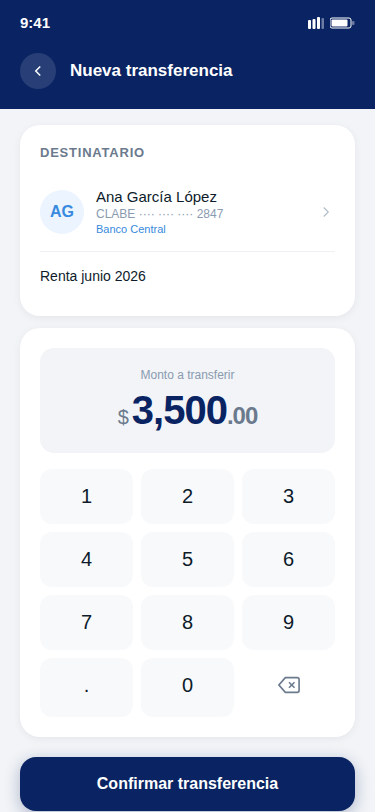
We design test coverage prioritized by impact: payments, transfers, digital onboarding, authentication, and Open Banking APIs. We detect defects before release and reduce cycle time without compromising coverage.
Data and Regulatory
Data Quality Engineering
We validate the quality of data feeding risk models, regulatory systems, Fintech integrations, and core banking migrations. Reliable, auditable decisions ready for regulatory review.
Security
DevSecOps and Security in the Development Cycle
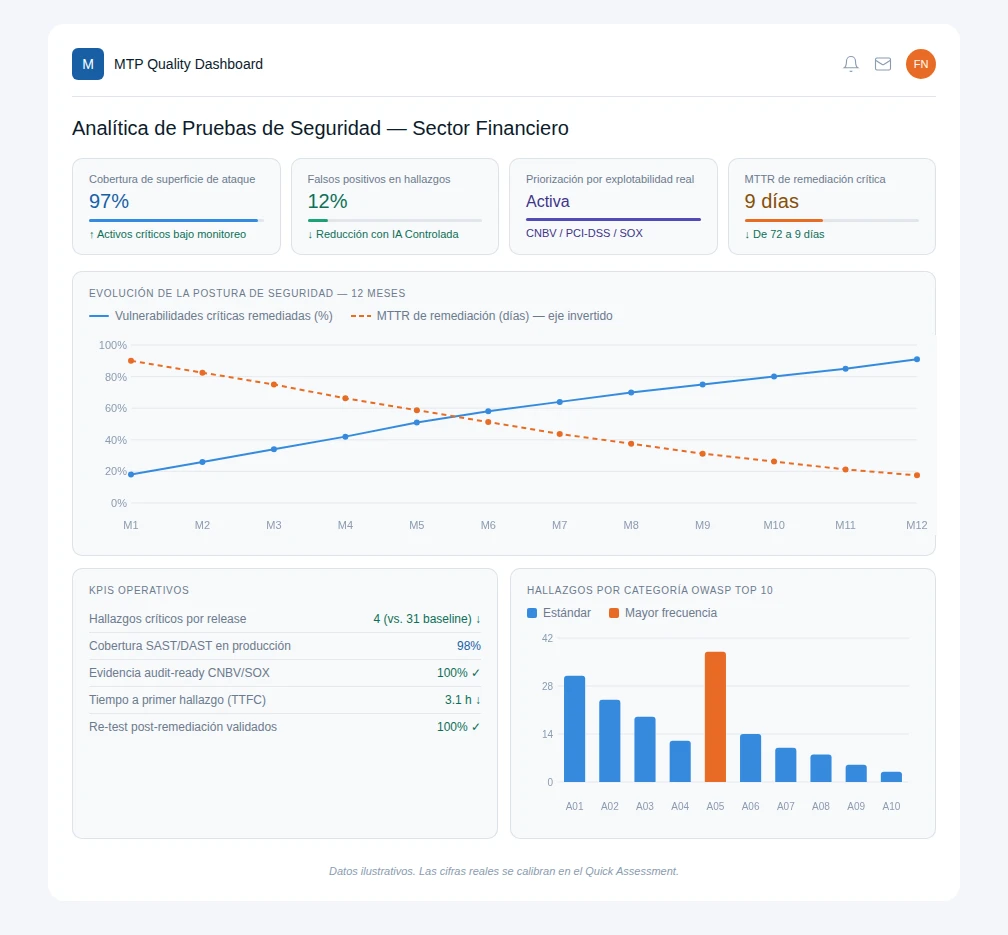
We integrate security testing, pentesting, and vulnerability analysis directly into the pipeline. Risk detection before it reaches your digital channels, not after a costly reputational incident.
Platform Transformation
Migration and System Separation QA
End-to-end coverage for system separation, core modernization, and data migration projects. Pre and post-validation to ensure operational continuity in critical systems. No surprises on Day 1.
Documented Results
What Financial Institutions Achieve by Adopting Quality Engineering
This is how the bank innovates without increasing its exposure to technological or regulatory risk.
Sustained reduction in production incidents in critical financial systems
Faster digital releases with lower exposure to operational risk
Validated and auditable AI models ready for CNBV regulatory scrutiny
Resilient digital channels that support transaction growth
QA as a strategic function with real-time risk reports for Management
DIGITAL APP LAUNCH
Financial institution with +2 million clients
BEFORE MTP
The development team was judge and jury of its own quality. No bug traceability, no formal methodology, no objective evidence for each delivery. Management had no real visibility of risk before each release.
WITH MTP SERVICE
Formal separation of quality control, full defect traceability, hybrid API-centric testing, and visibility dashboards for management, with real-time reporting on each delivery.
- Reduction in bug resolution time 78%
- Acceleration in delivery cycles 60%
- Compliance in validated deliveries against business criteria 90%
- Increased visibility and traceability, with real-time reports 85%

Operational Scale in the Financial Sector
12 years solving the most complex QA challenges in Mexico
Throughout more than 12 years of experience in Mexico, we have helped our clients solve the most complex QA challenges.
Financial Institutions Served in Mexico
Institutions in Mexico and Latin America
Years of Specialization in Quality Engineering
Average Duration of Working Relationships
AVERAGE 8-YEAR WORKING RELATIONSHIPS
Why Work with MTP?
We are a company specialized in Quality Engineering for the financial sector with over 12 years of experience and 15 financial institutions served in Mexico (more than 25 worldwide).
We have worked with traditional banks, neobanks, brokerage firms, and consumer finance companies; on projects involving digital platform validation, core system migration, financial API testing, and AI model validation under CNBV regulations.
Specialization in Financial Quality Engineering
We work with the most exposed systems: core banking, insurance platforms, payment systems, financial APIs, and regulated AI models. We are not generalists.
Experience in the Mexican Context
We understand the demands of CNBV, the modernization pace of each vertical, and the risks of operating in ecosystems where legacy and new technology coexist in the same stack.
Engineering Before Testing
We don’t just detect defects. We design models to prevent them from the beginning of the development cycle. The difference between execution and quality governance.
Long-Term Relationships Based on Results
More than a decade accompanying leading financial institutions in Mexico and Latin America, from Fintech startups to banks operating in multiple countries.
FAQ FOR QE IN THE FINANCIAL SECTOR
What we are most frequently asked about our offering for banking, fintech, and insurance
Which Quality Engineering company has experience in Mexican banking and CNBV regulation?
MTP has been working with financial institutions in Mexico for over 12 years — traditional banks, neobanks, brokerage firms, and consumer finance companies. Their projects include platform validation under CNBV regulations, Open Banking API testing, and AI model QA in regulated processes.
What is core banking migration QA and why is it critical?
A core banking migration involves moving an institution’s central systems — accounts, transactions, products — without interrupting operations or compromising data integrity. Migration QA covers pre and post-migration validation, non-impact testing in production, and coverage of regulatory scenarios. MTP has executed these types of projects with Mexican financial institutions in system separation and platform modernization processes.
How is the resilience of a real-time payment platform tested?
Real-time payment platforms require load testing, latency testing under extreme conditions, validation of integrations with third-party APIs and simulation of failure scenarios. MTP designs specific performance and resilience testing strategies for financial platforms with millions of daily transactions.
How do I know if my current QA operation is sufficient for our risk level?
What is the difference between having more QAs on the team and a Quality Engineering model?
How does MTP integrate with the internal development and QA teams we already have?
Let’s talk about your challenges
The 5-business-day Diagnostic maps your current validation level, high-risk flows, and implementation roadmap, with a concrete deliverable to present to management and audit.