
When traffic spikes don’t forgive mistakes
Performance Testing: Validate the user capacity your system supports before the next spike
We scale your software’s capacity with Omniatest®, so it can handle real traffic on the day that matters most.

Trusted by organizations that validated their capacity before their most critical spike































Three Scenarios, One Business Risk
The problem isn’t your app’s performance; it’s what’s missing behind it: strategy, architecture, and method
Without Performance Testing
No one has measured the system’s breaking point. The first real capacity data arrives on the day of the event, when there is no longer any room to correct anything.
Performance Testing Without Strategy
Isolated load tests exist, but they do not simulate real traffic or critical business flows. What is easy to automate is tested, not what actually crashes the system.
Performance Testing Without Governance
Each team monitors its own layer—app, database, infrastructure—without a single overview of capacity. AI, when it exists, lives in scattered alerts that no one prioritizes based on business criteria.
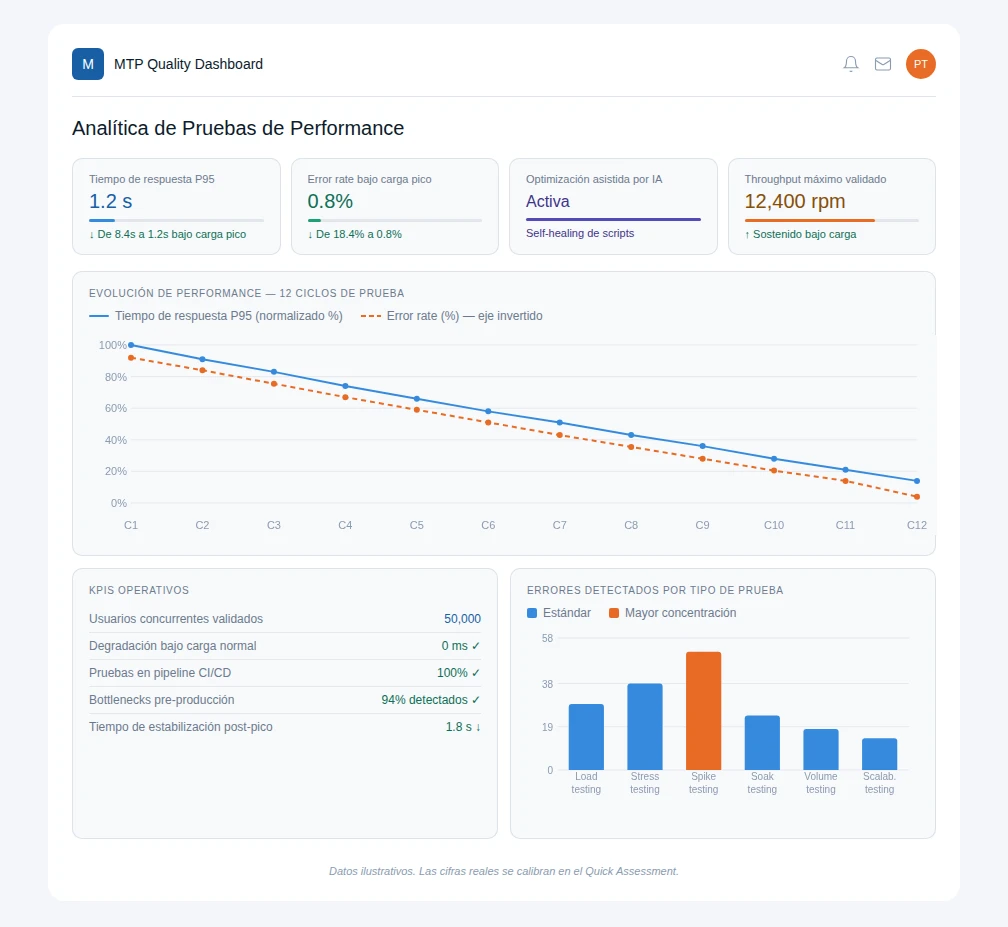
Whatever your scenario, the root cause is the same: performance tests are not designed with the strategy and method the business needs. That is what we design. Regardless of your starting point.
The real cost of performance without designed quality
The cost of not validating capacity before the spike doesn’t appear in the IT budget; it appears in the business results
Minimum cost of one hour of downtime for 97% of large enterprises
– ITIC 11th Annual Hourly Cost of Downtime Survey, 2024
|
$15K per min |
Average cost per minute of downtime, up to $600B in combined annual losses for Global 2000 companies (Splunk/Cisco 2026) |
| 100× | More expensive to detect a performance failure in production than in early development phases (IBM Systems Sciences Institute) |
| 97% | Of large enterprises report that one hour of downtime costs more than USD $100K (ITIC 2024) |
Where does the real cost appear in your organization?
Sales that don’t return. Every minute of downtime during your most important event translates directly into non-recoverable revenue.
Silent cart abandonment. The cart is abandoned when the page takes more than a few seconds to respond, without anyone noticing in time.
The breaking point is discovered in production. The team finds the system’s limit in front of the customer, not in a controlled environment where action can be taken.
Hope instead of evidence. Every high-traffic campaign is planned hoping the infrastructure will hold up, not with data confirming that it will.
Lagging behind competitors using AI. While other organizations anticipate bottlenecks before the spike, yours continues to react when the system has already degraded.
The same architecture without scaling. Demand spikes (launches, campaigns, live events) continue to hit a system that was not designed to handle them.
MTP Framework, Omniatest® · TMMi Level 5 · Controlled AI
Capacity measured against the highest standard, not a generic billed hour of monitoring
The same methodology that made us the first company in the world to be TMMi Level 5 certified is what we apply to validate your capacity before the most important spike.
Capacity Measured Against the Highest Standard
We don’t simulate generic traffic: we design load scenarios that reproduce the real behavior of your users at the moment that matters most.
A Number Your Business Can Use to Decide
We deliver the Capacity Baseline Assessment in 5 business days: how many users your system supports today and where it begins to degrade. We don’t bill hours; we commit to a number.
AI That Anticipates the Bottleneck, Doesn't Guess It
Our AI analyzes historical traffic patterns to design realistic scenarios and detect bottlenecks before production. Every finding undergoes expert validation before becoming a recommendation.
Simulated Spikes That No Competitor Matches
We execute tests up to 10× the normal traffic of our retail and media clients. More than 900,000 tests per year in banks and retailers in Mexico, Spain, Brazil, USA, and Sweden.
What changes when the system is ready before the event
Results the business recognizes, not just the technical team
Zero Surprises During the Spike
The system handles the real load of the event, not what was expected to be handled. Management enters the day of the event with evidence, not faith.
Less Abandonment Due to Slowness
Response times stay within the threshold that retains the user. The cart is not abandoned because the page takes too long to load.
Infrastructure Decisions with Evidence
You know how much capacity to scale, and when, before overspending. Architectural decisions are based on data, not intuition.
AI That Anticipates, Doesn't React
Bottlenecks are detected before the event, with expert governance for every finding. AI stops living in alerts that no one prioritizes.
One Less Spike, One More Certainty
Every critical event leaves a more solid capacity baseline than the previous one. The organization learns and does not repeat the same risks.
Executive Confidence in IT
The QE function evolves from a last-minute formality to a strategic capability. The IT department enters the event with visibility, not uncertainty.
PERFORMANCE TESTING OPERATIONAL PROCESS
From unknown capacity to a system ready for the spike—this is how we operate
Capacity Baseline Assessment
We measure your current capacity and estimate the breaking point before your next critical event. Deliverable in 5 business days, at no cost.
Real Load Scenario Design
We reproduce the real traffic of your users: complete flows, not isolated transactions, aligned with the upcoming event.
AI Prioritization of Risk Patterns
An AI engine analyzes historical traffic patterns to prioritize scenarios and components with the highest risk of becoming a bottleneck.
Load, Stress, Scalability, and Stability Testing
We execute from normal traffic up to several times the expected spike, integrated with JMeter, LoadRunner, Azure DevOps, Jenkins, and Grafana.
Monitoring and Recommendations with a Specialist
We monitor response times, throughput, and breaking points in real time, with expert validation before recommending any architectural adjustments.
Baseline Ready for the Next Event
We repeat the tests after each adjustment and leave a documented capacity baseline ready for the next critical event.
Proven Experience
Experience in environments where an error during the spike has no second chance
Financial Sector
Point of Sale system migration in 80+ stores validated under peak traffic conditions
- 100% coverage in critical modules that process transactions during peak demand moments
- 86% effectiveness in system stabilization after roll-out, without degrading in-store response times
- 5.33 average days to address performance findings with total visibility from the first cut
- Validation under peak traffic conditions, not just functionality
“We validated the migration under real store traffic before the roll-out. The team arrived at the day of the change with evidence, not expectation.”
— IT Director, Retail Sector
Financial Sector
Digital channel launch for an institution with 650,000 clients and 100 branches validated under real spikes
- Validation under real account opening spikes, not just functional tests
- More than 50,000 customer openings processed after launch with no reported degradation
- Specialized performance and mobile QE team scaled without slowing down the launch
- Stabilized backlog and QE function evolved from a formality to a strategic capability
The digital channel launch supported the real demand for account openings from day one, without degrading service for our existing customers.
— CIO, regional financial entity
Verified operational scale
Operational Scale of Performance Testing in Mexico
Incidencias Detectadas
Casos de Prueba Automatizados
Horas de Testing
Casos de Prueba Diseñados
Evaluation stage
Frequently asked questions about our Performance Testing offering
Do MTP performance tests integrate with the tools we already use?
Yes. MTP executes load and stress tests integrated into your monitoring and CI/CD stack—JMeter, LoadRunner, Azure DevOps, Jenkins, Grafana, among others—without asking you to migrate tools to validate your capacity under Omniatest®.
How does MTP use artificial intelligence in performance testing while still complying with our regulations?
MTP's AI analyzes historical traffic patterns to design load scenarios and anticipate bottlenecks, but every finding undergoes expert validation before becoming an architectural recommendation—MTP's Controlled AI model—with your regulatory frameworks (PCI DSS, CNBV, depending on your sector) as test criteria from the scenario design phase.
How long does a performance test with MTP take before a critical event?
The Capacity Baseline Assessment is delivered in 5 business days, at no cost, and confirms your current capacity. The full execution of load, stress, scalability, and stability tests is dimensioned according to the complexity of your system and the date of your critical event.
What is the difference between load, stress, and scalability tests?
Load tests validate behavior under normal and maximum expected traffic; stress tests look for the breaking point under extreme conditions; scalability tests confirm that the system supports more users without losing performance. MTP integrates them into a single capacity diagnosis under Omniatest®.
What happens if my system fails during testing and not before the event?
It is exactly the result we seek: finding the breaking point in a controlled environment, with an MTP specialist interpreting every finding, instead of your team discovering it in production in front of the customer on the day of the event.
What does the stability test include and why is it different from the others?
Unlike load or stress tests, which last minutes or hours, the stability test runs the system at a sustained load for an extended period to detect gradual degradation, memory leaks, or connection buildup—failures that only appear over time, not in short tests.
Do I need to have a specific event to request the Capacity Baseline Assessment?
No. Although the service is designed to prepare you for a spike or critical event, you can also request it simply to know your current capacity baseline, without a specific date in mind.
What happens after the Capacity Baseline Assessment if I decide to move forward?
The baseline identifies which types of tests to apply and in what sequence according to your event and architecture. From there, MTP executes the integrated load, stress, scalability, and stability diagnosis under Omniatest®, with expert monitoring and prioritized architectural recommendations.
Which of the three scenarios is your organization in?
The 5-business-day Assessment maps your current maturity level, projected TCO, and potential ROI, with a concrete deliverable to present to management.