
For CTOs, QA Directors, and Product Leaders facing escape rate pressure
Functional Testing: defect-free releases in every critical business flow
We structure your functional testing practice and AI-assisted design to reduce the escape rate with business value metrics — from risk-oriented design to real CI/CD integration.
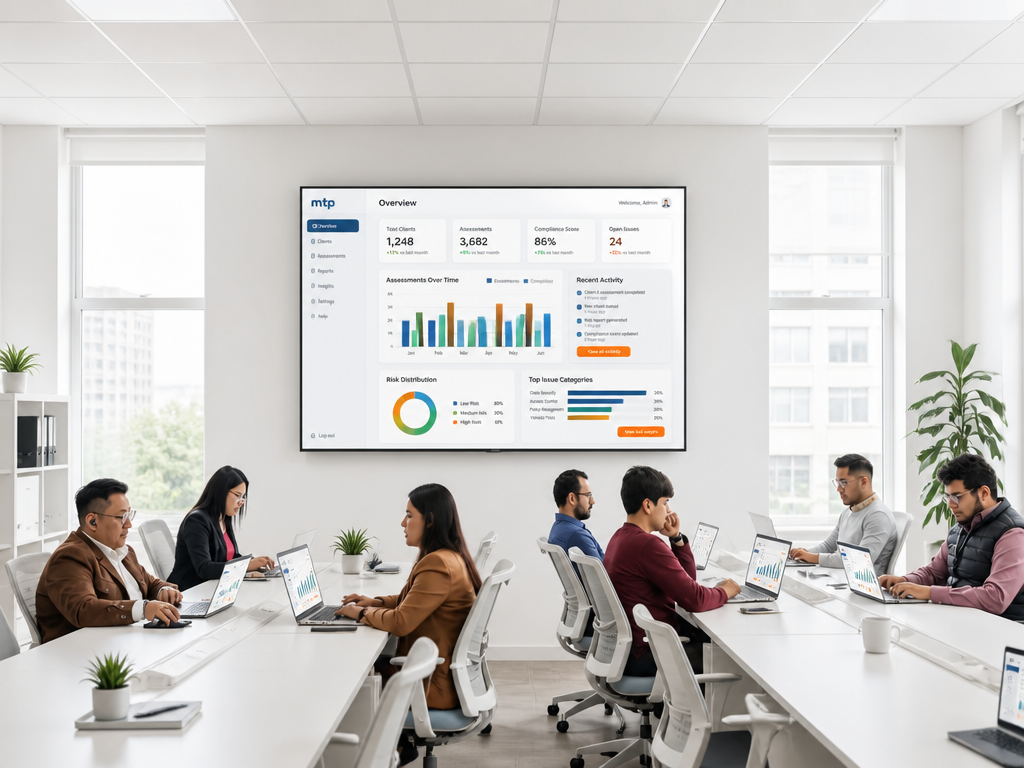
Trusted by organizations where errors in critical flows are not an option































The problem isn’t functional testing, it’s what’s missing
Three Scenarios, One Business Risk
In the organizations we advise, we see three distinct scenarios. Although they have their own symptoms, they share the same consequence: when functional testing practice is not strategically designed, the business absorbs the risk.
Testing Without Strategy
Validation depends on the available developer and focuses on happy paths. Each release negotiates coverage against deadlines — defects appear in production, and the root cause is diluted among development, QA, and product. There’s no way to anticipate what will fail or how much it will cost to fix.
Coverage Without Governance
There are cases, but no risk matrix or cross-cutting traceability. The catalog inflates with obsolete items, and no one can explain to management why the escape rate isn’t decreasing with a dedicated team. Each new feature adds load, it doesn’t remove it.
No Governance in Complex Environments
Multiple squads and vendors, high coverage on paper. AI operates in isolated pilots, generating cases that no one reviews against compliance, without quality gates in CI/CD. Each release remains uncertain — with the added burden of more case volume and less clarity on which ones matter.
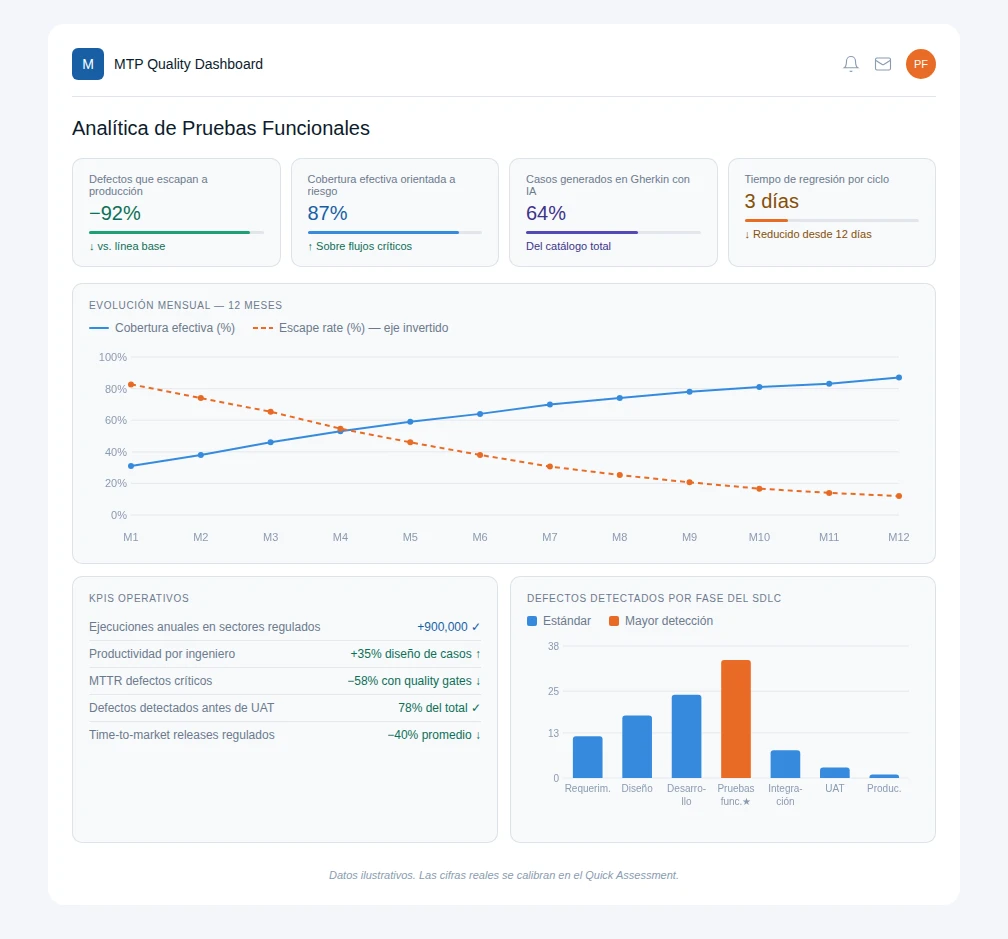
Whatever your scenario, the root cause is the same: functional quality is not designed with the strategy, risk-oriented design, and governance that the business needs. That’s what we design.
The cost of poor functional quality doesn’t appear in the IT budget; it appears in the business’s bottom line
The annual cost of poor software quality globally
– CISQ (Consortium for Information & Software Quality)
| 67% |
Defects are introduced in design or requirements, |
| 63% |
Fewer errors in companies with a strong quality culture |
|
500 thousand |
Functional test cases executed annually by MTP |
Where does the real cost appear in your organization?
Unbudgeted hotfixes resolving defects that functional regression should have caught two sprints earlier — consuming critical team time
Inflated catalog of obsolete cases that stopped detecting relevant defects several releases ago but still consume execution and maintenance time
Escape rate that doesn’t decrease despite more personnel because the problem is the practice’s design, not the headcount — more executors on a broken architecture only scale the problem
Postponed releases waiting for regression cycles that fail to test critical flows before the committed business date
AI in pilots without governance generating cases that no one reviews against compliance or defined acceptance criteria — volume without value and without an audit trail
Erosion of executive trust in IT when the escape rate doesn’t improve despite QA investment — and management cannot see concrete metrics per critical flow
Omniatest®, MTP’s proprietary Framework
We don’t just promise functional testing: we deliver results that are only achieved with method, risk-oriented design, and support
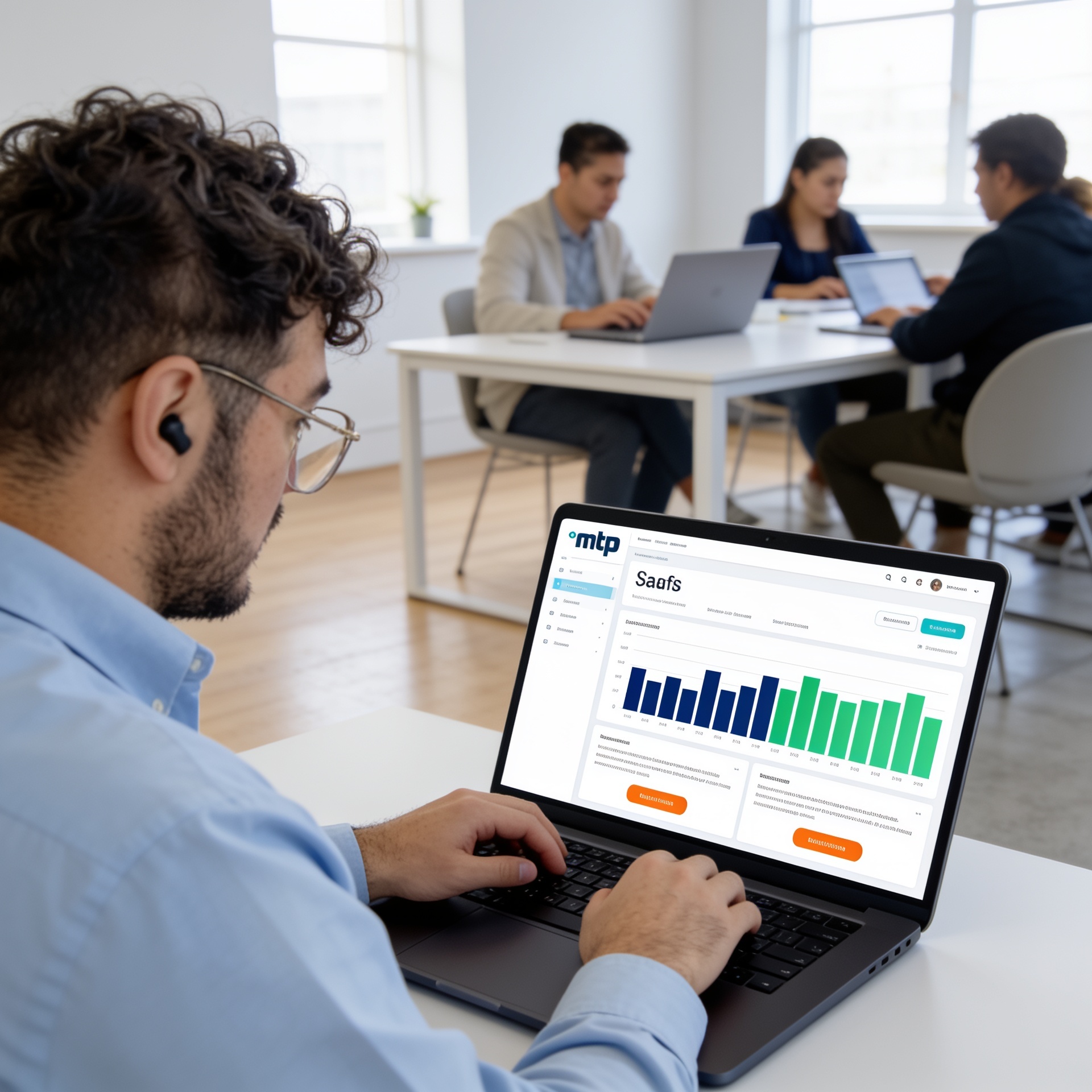
Omniatest® standardizes case design, test data, and environments from the first sprint. The escape rate is not a surprise data point at the end of the release; it’s a metric the CIO consults before the committee meeting.
Risk-Oriented Design from the Origin
AI Generation with Certified Expert Validation
AI agents generate Given/When/Then cases at the speed of hours. ISTQB certified experts validate every critical decision with a complete audit trail. Only those who operate under CNBV, Condusef, and SOX with regulatory traceability build it.
QE Factory or Embedded Cell According to Your Scenario
Measurable Escape Rate, Not Percentage of Cases Executed
When Functional Practice is Designed and Governed
Results the business recognizes, not just the technical team
Functional Quality Gates per Critical Flow
Objective go/no-go criteria per flow, not per global execution percentage. Management knows what risk it accepts before approving the release, not after the incident.
Prioritized Risk Matrix
Catalog calibrated to financial, commercial, and reputational impact, not to the calendar. QA resources are concentrated where a defect has the greatest consequence for the business.
Gherkin Generation with AI + Human-in-the-Loop
The team returns to designing strategy, not writing repetitive cases. AI generates at the speed of hours; the ISTQB expert validates before execution. Complete audit trail from requirement to case.
CI/CD Integration with Go/No-Go by Risk
Connection to Jenkins, Azure DevOps, or GitLab. Quality gates that adjust rigor to change risk, not volume. Each commit triggers calibrated coverage without blocking the development pipeline.
Executive Visibility with Real Escape Rate
Dashboard with escape rate disaggregated by critical flow and by release. The CIO consults comparable metrics across squads, releases, and vendors — without subjective interpretation from the QA team.
Optimized Regression Cycles
Progressive reduction of regression cycle time by eliminating obsolete cases and concentrating execution on critical items. Time-to-market ceases to be the cost paid for quality.
FUNCTIONAL TESTING OPERATIONAL PROCESS
From production defects to surprise-free releases, this is how we operate
Functional Testing Quick Assessment
Current escape rate, maturity of the case catalog, stack complexity, and projected ROI. A clear map of the root cause, not the symptom, and the cost of inaction.
Mapping Critical Flows
Identification of flows with the greatest financial, commercial, or reputational impact. Prioritization of what to cover first, not covering everything; the catalog is calibrated to change, not to the calendar.
Risk-Oriented Catalog Design
AI agents generate Given/When/Then cases; ISTQB certified experts validate every critical decision with a complete audit trail per case, from requirement to execution evidence.
Execution: Functional, Regression, SIT, and UAT
Functional, regression, SIT, and UAT testing in work cells or a QA factory. Integration with REST, gRPC, GraphQL, and Kafka for critical services and APIs.
Pipeline Integration and Quality Gates
Connection to Jenkins, Azure DevOps, or GitLab. Go/no-go by change risk and unified visibility across squads, releases, and vendors — without a dashboard parallel to the pipeline.
Continuous Catalog Evolution
Quarterly evolutionary maintenance, obsolete case purging, and expansion of risk-oriented coverage that changes release to release. Knowledge remains installed, quality as an organizational capability.
Experience in environments where functional defects are not an option
Two contexts, same demand: zero escape rate in critical business flows
Financial Sector
+500,000 functional cases annually with zero incidents in SPEI, card activation, and digital onboarding flows
- +500,000 functional test cases executed annually
- 0 critical post-release incidents in SPEI, card activation, and digital onboarding
- +30 simultaneous projects with operational visibility to the committee
- Validation on +200 simultaneous physical devices under CNBV and PCI-DSS
“Coverage ceased to be a PowerPoint figure. The committee now sees escape rate per critical flow and makes release decisions with data.”
— Director of QE, Financial Sector
Private Industry
18 critical applications in system separation with functional testing across 70 applications
- +20,000 hours of functional, regression, and UAT testing
- Pre and post-migration cycles across 70 applications in total
- 0 critical incidents in production after release
- Recovery of 3 months of delay converted into controlled deliveries
A project of this magnitude — 18 critical applications, parallel SOX processes — requires method, not just resources. The escape rate was zero in production.
— MTP International
Verified operational scale
12 years executing functional testing in Mexico’s most demanding environments
Incidencias Detectadas
Casos de Prueba Automatizados
Horas de Testing
Casos de Prueba Diseñados
Evaluation stage
Most Frequently Asked Questions About Enterprise Functional Testing
What is Risk-Oriented Coverage vs. Traditional Coverage?
Traditional coverage aims to execute the entire catalog of existing cases and report a percentage. Risk-oriented coverage prioritizes flows based on financial, regulatory, or reputational impact — the catalog is executed calibrated to change, not to the calendar. This reduces regression cycles, lowers the escape rate on critical items, and frees up capacity to design new cases instead of maintaining obsolete ones.
How Does AI Work in Functional Testing?
AI operates in three modes calibrated to the regulatory framework: AI First to generate cases in Gherkin at the speed of hours with expert validation before execution; Controlled AI (Human-in-the-Loop) when customer data cannot leave the regulated perimeter; and No AI / Compliance-Ready for validations under CNBV, Condusef, or SOX that require explicit and signed human supervision. Each generated case leaves an audit trail with author (human or agent), reviewer, and traceability to the requirement.
What Does the Functional Testing Quick Assessment Include?
A 5-business-day analysis that delivers: current escape rate and its structural root cause, case catalog maturity, stack complexity, and projected ROI. In 30-60 days, we establish the baseline practice: initial Gherkin catalog, effective coverage matrix, measurable escape rate, and first executive dashboard.
How is Traceability Generated with an Audit Trail in Functional Testing?
By recording each case with its author (human or AI agent), ISTQB certified reviewer, approval decision, and traceability to the original requirement. This allows auditors to reconstruct what was tested, who validated it, and what acceptance criteria were applied — a frequent requirement in CNBV, Condusef, SOX, and PCI-DSS audits.
What Tools Does MTP Use for Functional Testing?
MTP operates with Omniatest® as its proprietary Framework, AI-assisted Gherkin case design, and integration with Cucumber, Selenium, Playwright, Appium, mabl, testRigor, Jira, and Xray. For APIs and services: REST, gRPC, GraphQL, and Kafka events. Quality gates connected to Jenkins, Azure DevOps, and GitLab. Project-specific selection is defined in the Quick Assessment based on your current stack and regulatory framework.
How is the Escape Rate Systematically Reduced?
Attacking the root cause, not the symptom. 67% of defects are introduced in design or requirements: that's why shift-left to Gherkin from the origin is structural, not cosmetic. Afterwards: risk matrix per critical flow, quality gates in CI/CD that adjust rigor to change, and an executive dashboard with escape rate disaggregated by flow and by release. Without these three elements, the escape rate returns to its baseline in three sprints.
What Delivery Models Does MTP Offer for Functional Testing?
Five models depending on the scenario: multidisciplinary cells embedded in agile squads; managed QE factory for centralized demand; time and materials for specific certified profiles; closed project when the scope is defined; and maturity consulting to elevate the practice. In all cases: cross-functional governance with clear RACI, unified metrics, and a dashboard that the CIO consults before the committee meeting.
How is the ROI of Functional Testing Justified to the CFO?
Measuring the cost of escaped defects vs. defects caught in QA, the cost of unbudgeted hotfixes, the cost of manual regression on inflated catalogs, and the impact on time-to-market. Risk-oriented functional practice quantifiably reduces the COPQ (Cost of Poor Quality) from the first quarter of operation.
Which of the three scenarios is your organization in?
The 5-business-day Assessment maps your current maturity level, projected TCO, and potential ROI, with a concrete deliverable to present to management.