
For companies where friction costs customers
UX & UI Testing: Experience validation that reduces churn
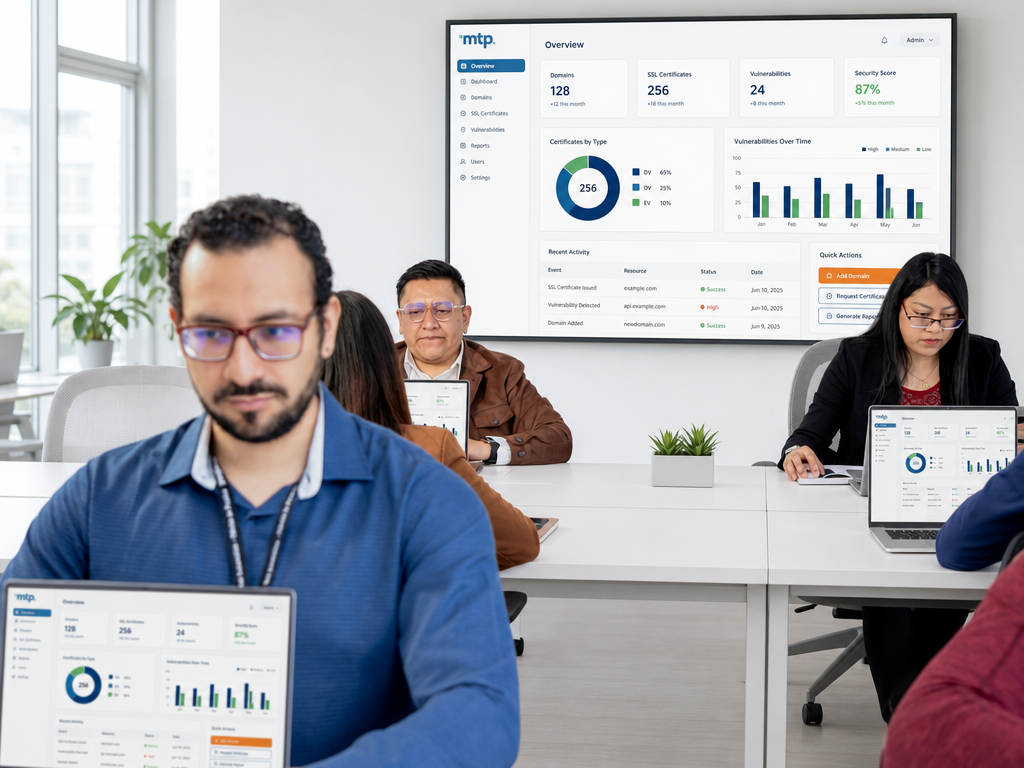
We build or redesign your experience validation architecture so that every release reaches production with full accessibility compliance and early business visibility.
Trusted by organizations that reduced churn by validating experience before every release

























The problem isn’t the testing; it’s what’s missing behind it
Friction doesn’t appear in the QA report. It appears in the drop in conversion.
Friction discovered only in production
You pass functional and performance QA, but user friction only appears in production: store reviews, low NPS, or conversion drops.
Isolated sessions without traceability
You run isolated sessions before major releases. Findings live in presentations that no one uses, with no friction-to-code traceability.
Validation in silos without a common framework
Multiple teams validate experience, accessibility, and A/B testing without a common framework. AI operates in silos, and no one anticipates where the next friction point will appear.
Which describes your situation? Whatever your scenario, the root cause is the same: without an experience validation architecture, the business pays for friction in lost conversions. That is what we design.
The numbers behind the churn
Average shopping cart abandonment rate in eCommerce—most of these exits are documented and resolvable frictions
– Baymard Institute, 2024
| 70% |
Of global executives recognize |
| +35% |
Average achievable conversion increase |
| WCAG 2.2 AA | Validated accessibility coverage EN 301549, ADA Title III, and EAA — MTP International |
Where does the real cost appear in your organization?
Post-release UX hotfixes that consume product capacity and block the next sprint’s roadmap
Fines and lawsuits due to non-compliance with WCAG 2.2 AA, EN 301549, ADA Title III, and EAA
Abandoned carts and forms that are dismissed as “unengaged traffic” when they are documented and resolvable frictions
High MTTR for experience incidents; no one knows if it was the screen, validation, copy, or a poorly deactivated experiment
Product decisions without evidence, lacking SUS, digital NPS, or heatmaps comparable across sprints
Lagging behind organizations that already operate automated visual testing and AI-driven WCAG validation
MTP Framework, Omniatest® applied to UX and accessibility
What sets us apart is not the tooling, but the architecture.
We measure success by sustained business metrics per release, not by billable hours.

Omniatest® from the first sprint
UX quality gates integrated into the pipeline, with traceable metrics release after release. Validation is not an event; it is part of the delivery process.
Results over hours
We measure success by sustained SUS per release, not by billing. Your business improves its conversion; we measure it and make it sustainable.
AI + Human-in-the-Loop
Prioritization of frictions with auditable evidence. AI identifies and classifies; the human specialist validates critical decisions.
TMMi Level 5 — the highest in the world
The first company in the world to be certified TMMi Level 5. Over 200 ISTQB-certified specialists. Methodology proven on a global scale.
What changes when the experience is validated
Results that the business and users recognize
Objective criteria before the release
Each sprint closes with objective criteria. Management knows what is going to production before it gets there.
Correction costs drop by 5x to 10x
UX defects detected within the sprint, not in production. The cost of correction drops by 5x to 10x.
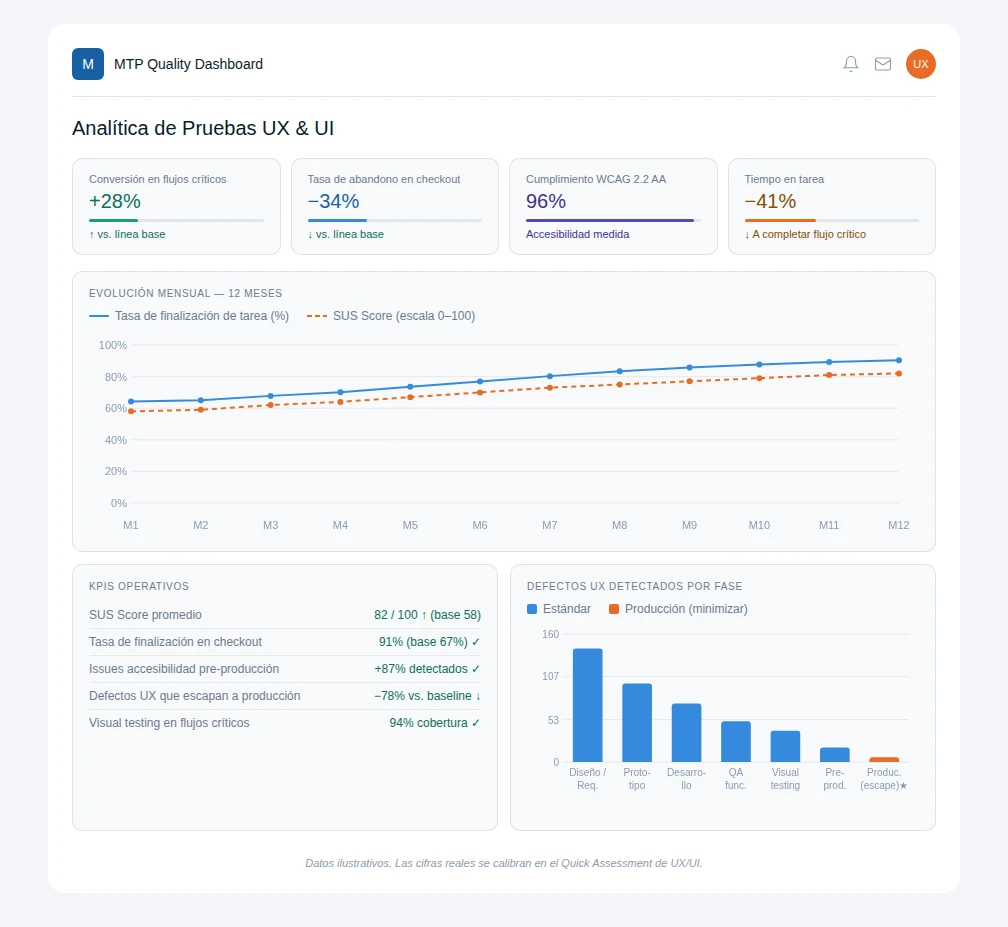
A unified dashboard, not loose presentations
SUS, digital NPS, heatmaps — comparable iteration to iteration. No silos, no isolated presentations that aren’t reused.
In-house capability, not vendor dependency
Capability remains in your organization after MTP’s departure. No permanent vendor dependency.
Accessibility as a quality gate, not an isolated audit
WCAG 2.2 AA, EN 301549, ADA Title III, and EAA validated release by release, with audit-ready evidence — not as a last-minute annual review.
Conversion that Management can track release by release
Usability improvement stops being a design hypothesis and becomes a business metric with a potential +35% conversion increase, measurable sprint by sprint.
UX & UI TESTING PROCESS
From friction to quality gate in 6 steps
UX Quick Assessment
Current maturity, WCAG 2.2 AA gaps, friction points per journey. Diagnosis delivered in 5 business days with a prioritized action plan.
Critical journey mapping
Identification of flows with the highest risk of churn and regulatory friction. Prioritization with quantitative evidence.
Validation architecture
Quality gates per sprint, validation levels (visual, functional, accessibility, A/B), and target metrics aligned with the business.
Quality gates in the pipeline
Objective exit criteria integrated into the pipeline. AI prioritizes findings; a human specialist validates critical decisions.
Continuous operation
Unified dashboard per release. Comparable metrics iteration to iteration. Early visibility for Management before each release.
Training and transfer
ISTQB certification for the internal team. Capability remains in your organization. No permanent vendor dependency.
Global scale
Proven in the most demanding operations
Financial Sector
UX validation pipeline stabilized with greater confidence for Management
- +30 simultaneous experience validation initiatives
- +900K annual visual and accessibility validation executions
- +20K hours of automation in critical journeys
- Multi-vendor model without dependency on a single tool
“We stabilized our pipeline and today we release with greater confidence for Management.”
— IT Director, Financial Sector
Private Sector
Controlled release of digital experience without impact on internal customers or vendors
- Controlled release without impact on internal customers or vendors
- UX acceptance criteria defined per sprint before the release
- Accessibility quality gates integrated into the actual pipeline
- Unified dashboard for SUS, NPS, and heatmaps per release
We were able to release our applications in a controlled manner without impact on internal customers and vendors.
— IT Director, Private Sector
Verified operational scale
Proven in the most demanding operations
Issues Detected
Automated Test Cases
Testing Hours
Test Cases Designed
Evaluation stage
Everything you need to know before starting
How does the MTP service differ from the work our UX team already does?
MTP designs the validation architecture that connects UX findings with sprint exit criteria and pipeline traceability. It does not replace the design team; it instruments the process so their findings are actionable and measurable release after release.
How does the service integrate with our agile process?
It integrates from the sprint refinement: definition of UX acceptance criteria, daily meetings with experience risk visibility, and quality gates connected to the pipeline. It adapts to Jira, Azure DevOps, or other tools.
What tools does MTP use for visual testing and UX?
Figma and Zeplin for design review, Selenium/Playwright for automated visual testing, heatmap and session recording tools, and WCAG 2.2 AA accessibility frameworks (axe-core, Lighthouse, NVDA/JAWS). The selection is defined during the Quick Assessment.
Does the service cover WCAG compliance and accessibility?
Yes. We cover validation under WCAG 2.2 AA, EN 301549, ADA Title III, and EAA as part of the framework. The evidence is audit-ready for regulatory inspections.
How long does it take for the first UX quality gate to be operational?
The initial Quick Assessment is delivered in 5 business days. The first quality gates integrated into the pipeline are operational in the first sprint following the diagnosis.
How does MTP calculate the economic impact of friction?
Based on your monthly visits, current conversion rate, and average ticket, we project potential revenue with a +35% conversion improvement (Baymard Institute benchmark) to size the monthly opportunity that unresolved friction costs your business.
What happens if my organization does not have a formal UX team?
It is not a requirement. MTP designs and implements the complete validation architecture—acceptance criteria, quality gates, dashboard—even if a dedicated UX team does not exist today. The capability is installed and transferred during the process.
Does accessibility validation generate valid evidence for a regulator or a lawsuit?
Yes. Each accessibility finding is documented with the applied rule, the tool used, and specialist validation, in an audit-ready format for inspections under WCAG 2.2 AA, EN 301549, ADA Title III, or EAA.
What are your users’ usability challenges?
The 5-business-day Assessment maps your current usability level, projected TCO, and potential ROI, with a concrete deliverable to present to management.