
When every project starts from scratch again
QA Best Practices: One Quality Standard, -50% Defects in Production
We implement a QA best practices model with Omniatest®, so that quality no longer depends on the memory of a single person.
Up to 60 minutes with a consultant and a technical specialist.

Trusted by organizations that have institutionalized their QA practice






























The problem isn’t the QA best practices; it’s what’s missing behind them
Three scenarios where quality fails because each team defines its own rules
Without a Documented Method
Each tester tests their own way. There is no shared checklist or coverage criteria, nor a clear definition of what “ready for production” means. Knowledge lives in people, not in the process.
Practices Without Strategy
Manuals and checklists exist, but no one connects them to real business risk. The usual things are tested, not what has the most impact if it fails. Effort grows; risk coverage does not.
Practices Without Governance
Each team decides its own standard, without a model that standardizes processes across projects. AI, when it appears, does so in isolated silos that even the QA team itself doesn’t know exist.
Whatever your scenario, the root cause is the same: the implementation of QA best practices is not designed with the strategy and method the business needs. That is what we design.
The cost of poor quality doesn’t appear in the IT budget; it appears in the business’s bottom line
Fewer defects in production when processes are standardized with a QA maturity model
– Validated results from MTP clients
| 25% |
Of organizations have a mature quality model |
| 67% |
Of software errors |
| $2.4B |
USD per year |
Where does the real cost appear in your organization?
Each release depends on the same specialist remembering what to check
Defects that reach production are repeated because no one documented the root cause the first time
Each new project reinvents its own testing process, without a standard to support it
Quality audits are prepared by putting out fires, rather than showing continuous evidence
QA turnover takes knowledge with it, because it never lived outside of individuals
Falling behind organizations that already use AI to prioritize and predict defects with governance
Omniatest®, MTP’s Proprietary Framework
Why MTP for QA Best Practices Implementation
MTP designs implementation based on Omniatest®, the same methodology that made us the first company in the world to be TMMi Level 5 certified. We don’t teach maturity theory: we operate with the model that defines it.

Applied, Not Just Certified
We Measure Ourselves by Standardized Processes, Not Hours
AI Diagnosis Under Human Control
A History of Implementation, Not Just Diagnosis
When Quality Is an Organizational Capability
Results the business recognizes, not just the technical team
Up to 50% Fewer Defects in Production
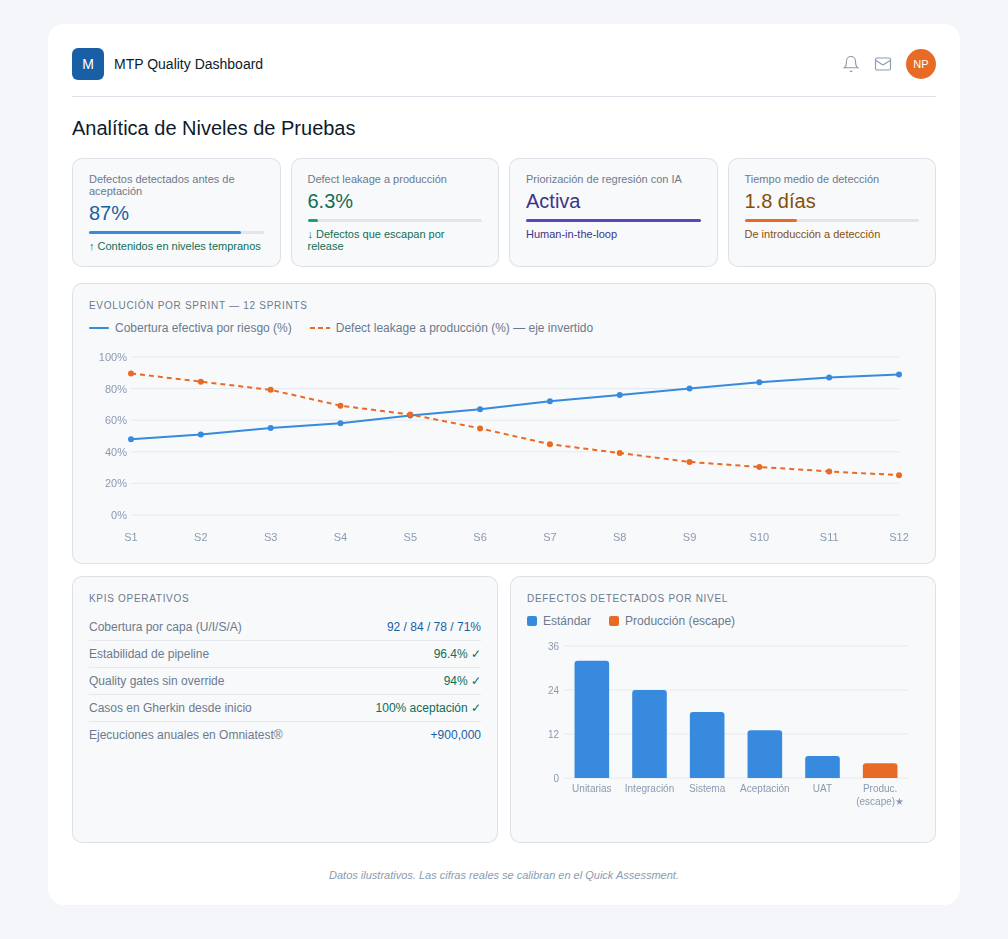
When processes are standardized under a QA maturity model, defects are detected before they reach the user, and the pattern is documented so they don’t repeat.
Audits Without Putting Out Fires
Continuous evidence of practice, ready before it’s requested. Auditing stops being a stressful event and becomes a demonstration of what is already working.
Teams That Don't Depend on One Person
Knowledge lives in the method, not in someone’s memory. When there is turnover, the standard remains, and the new member adopts it without reinventing the process.
Governed AI, Not in Silos
AI-assisted diagnosis and prioritization, with expert judgment in every decision. AI accelerates; the specialist validates, without compromising compliance or decision quality.
A Roadmap to TMMi, Not a Promise
A measurable path to maturity, with those who certified Level 5. Every milestone is auditable, every advancement documented, without depending on the institutional memory of whoever designed it.
Single Standard Across Projects
Without each team reinventing its own testing process. A governance model that standardizes practices across projects, areas, and vendors under a single criterion.
OPERATIONAL PROCESS FOR QA BEST PRACTICES IMPLEMENTATION
From Improvised Quality to Quality That Operates Without Us—This Is How We Work
QA Maturity Assessment
Diagnosis with interviews, TMMi/ISTQB checklists, and QMO 360° methodology. Structured deliverable with the current maturity level.
Prioritization and Roadmap
Findings prioritized by business impact. 12-month roadmap with quick wins in 30-60 days.
Governance Model Design
Standardized roles, policies, and standards across teams and projects. The model that defines how quality decisions are made.
Predictive Prioritization
AI analyzes the root cause of recurring defects and prioritizes which practice to implement first. Expert validation for every finding.
Pilot Projects and Documentation
We implement practices in pilot projects, adjust with the team, and document the installed standard.
Operation and Optimization
Measurement of adherence to the new standard. Evolution toward TMMi certification when the business decides.
Experience in Environments Where Error Is Not an Option
Two Organizations That Stopped Reinventing Quality in Every Project
Financial Sector
QE Standardization in a Banking Institution with 25 Million Clients
- +30 simultaneous transformation projects under a single standard
- Regulatory compliance built into every validation without slowing down delivery
- +300 standardized projects over 11 years of collaboration
- Full operational visibility for business and technology
“We stabilized our pipeline and now release with greater confidence to Management. Automation is no longer a risk.”
— IT Director, Financial Sector
Private Industry
Migration of Point of Sale and Warehouse Systems in More Than 80 Stores
- 100% coverage in critical modules during transition
- 86% effectiveness in post-rollout stabilization
- 5.33 days average defect resolution time with total visibility
- Continuous operation in 80+ stores throughout the project
The value the dashboards give us is agility: we have an immediate status, ready to review with Management, all the information in a single click.
— IT Leader, POS Project
Verified operational scale
28 years institutionalizing QA practices in Mexico’s most demanding organizations
Years of Operation in Quality Engineering
Projects Standardized Under Omniatest®
Average Duration of Working Relationships (Years)
First Company in the World to Achieve TMMi Level
Service Evaluation
Frequently Asked Questions About QA Best Practices Implementation
How long does it take to implement QA best practices with MTP?
Implementation takes between 2 and 4 months for medium-sized organizations, starting with the QA Maturity Assessment (2 weeks, no cost) and advancing through milestones defined in Omniatest®. Projects aiming for TMMi certification extend the roadmap to 12 months.
How does the implementation integrate with the tools we already use?
MTP standardizes new processes directly on your current stack — Jira, Azure DevOps, Jenkins, GitLab, among others — without requiring the team to migrate tools to adopt the Omniatest® standard.
How does MTP use AI while still complying with our regulations?
MTP’s AI diagnoses maturity and analyzes the root cause of defects, but every process change undergoes expert validation before being applied — MTP’s Controlled AI model — with documented evidence for ISO 27001, PCI-DSS, or CNBV audits depending on the sector.
What is the difference between the QA Maturity Assessment and Best Practices Implementation?
The QA Maturity Assessment diagnoses what level of the maturity model your organization is at; Implementation is the phase where MTP designs and standardizes the processes, governance, and certifications (TMMi, ISTQB) that close that gap.
Do we need to be TMMi certified to work with MTP on QA best practices?
No. TMMi certification is an optional path within the implementation, not an entry requirement — many organizations only seek to standardize processes and raise their maturity level without formal certification.
What if my organization has never measured its QA maturity?
That is exactly the starting point of the QA Maturity Assessment: it maps where you are today, without penalizing your starting point, and builds the best practices roadmap from there.
How is it prioritized which practice to implement first?
Assessment findings are prioritized by business impact, not by ease of implementation. The 12-month roadmap includes quick wins in 30-60 days to show value from the start.
Does the governance model standardize processes across different areas and vendors?
Yes. The governance model we design standardizes practices across projects, areas, and vendors under a single criterion, without each team reinventing its own testing process.
Let’s Talk About Your QA Best Practices Challenges
Tell us what is slowing down your releases. A specialist will respond with the next step.